Personal project · Free web tool
Redirect Audit: check a domain’s redirects at a glance.
I built Redirect Audit to answer a question I ask myself every time I launch a site: do all the addresses lead to the same place, with no detours? Just enter a domain to find out.
A technical detail that often goes unnoticed
The same site can be requested in four different ways:
- http://my-site.example
- https://my-site.example
- http://www.my-site.example
- https://www.my-site.example
Ideally, three of these addresses redirect to the fourth in a single step, with a permanent redirect (301). In practice, you often find a forgotten temporary redirect (302), a variant that doesn’t respond, or a chain of two or three hops. Visitors don’t notice anything, but the site is a little slower and search engines get less clear signals.
An example: cabana.dev
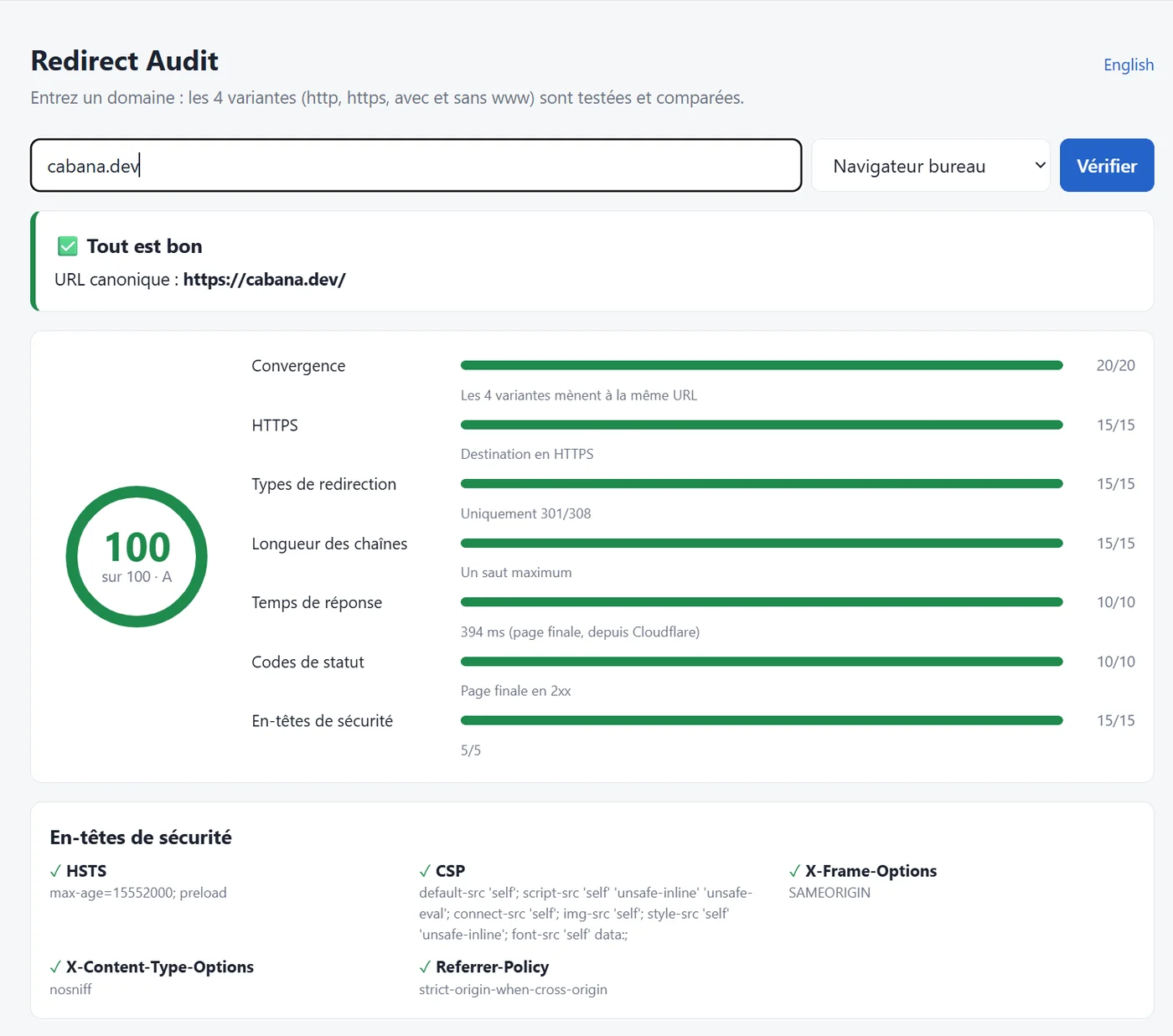
Here is the Redirect Audit result for this very site. The three other variants lead to https://cabana.dev with a single permanent redirect, the page responds quickly and all five security headers checked are in place.
Result: A · 100
This is the setup I aim for on every site I host. You can run the check again yourself: the result is calculated live.
What Redirect Audit checks
Redirect chains
Each variant is followed hop by hop, with its status code (301, 302, 307, 308…). The tool confirms they all end up at the same address, over HTTPS.
Meta refresh and JavaScript
Some redirects don’t go through the server but through the page itself. The tool follows meta refreshes and flags JavaScript redirects.
A grade and next steps
A score out of 100 breaks down convergence, redirect types, chain length and security headers, with an explanation for each issue to fix.
A lightweight tool, upfront about its limits
Redirect Audit runs on Cloudflare Workers: no server to maintain, fast responses anywhere in the world, and a tool that can stay free with no sign-up. It’s available in English and French, and you can choose the identity used for the check: desktop browser, mobile, Googlebot, Bingbot or social media crawlers.
Like any tool of its kind, it has limits. Checks are made from Cloudflare’s servers, not from the visitor’s browser, so a site that blocks bots may respond differently. JavaScript redirect detection covers the most common cases. These limits are stated right in the results, so everyone can interpret them correctly.
Redirect Audit is my personal project. This page presents the thinking behind it; the tool itself is at redirectaudit.com.

